
People like tidy origin stories. They make the past feel manageable.
So the popular version goes like this: Jews arrive in England after 1066, under the Normans, and before that there is essentially nothing to say. In one narrow sense, that’s true. In the broader sense, it’s a story made cleaner than the evidence allows.
The careful scholarly position is unambiguous: there is no reliable evidence that Jews settled in England, or had sustained contact with the English, before 1066. If you want to write seriously, you have to hold that line. The temptation to “fill the gap” is strong, and it’s exactly what a serious piece must resist.
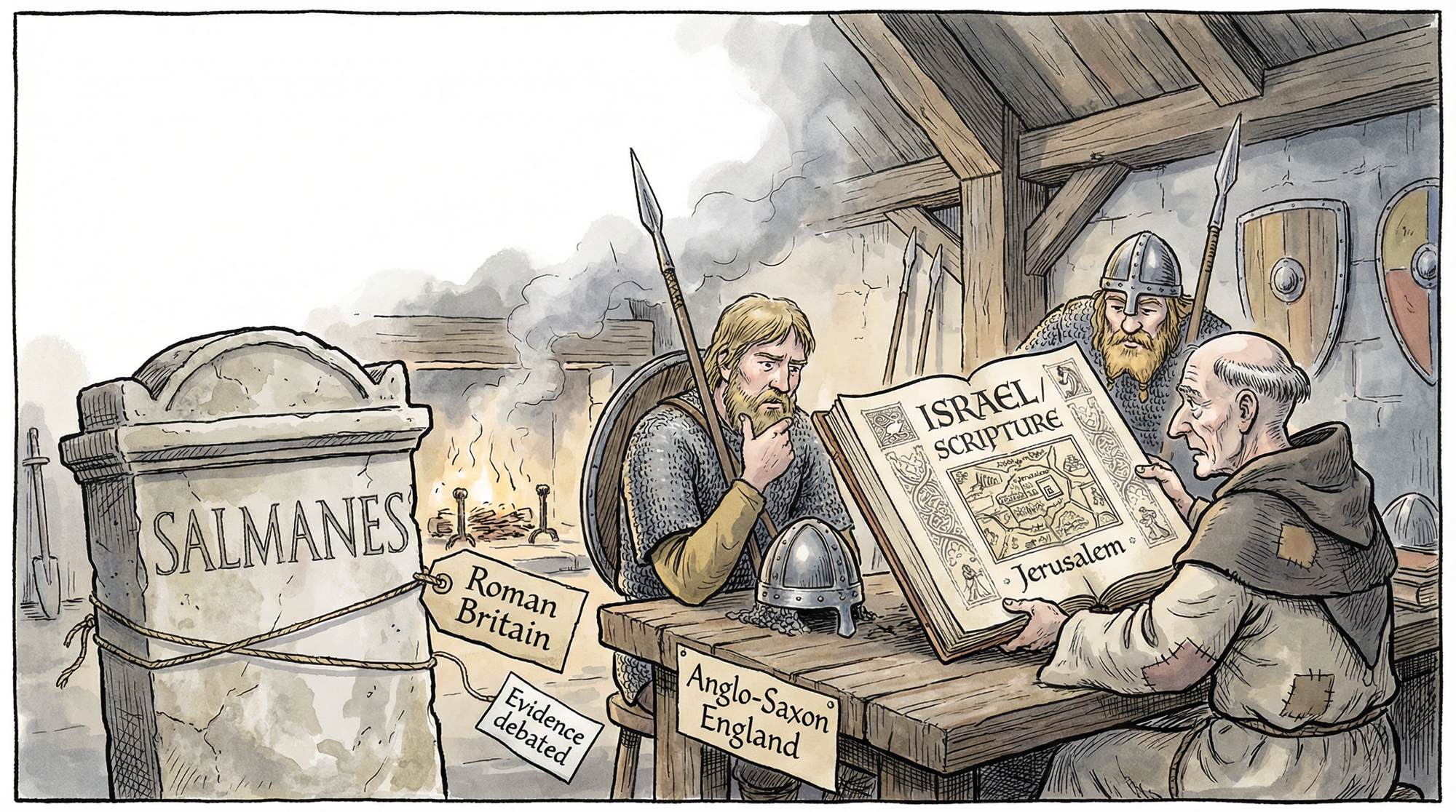
But it does not follow that Jewish history in Britain begins in the Norman era, nor that Anglo-Saxon England was ignorant of Jews and Israel. What follows is the more accurate, more interesting claim: Jewish presence in Roman Britain is at least plausible in specific cases, and Anglo-Saxon culture—whether or not it had Jewish neighbours—treated Israel as sacred, authoritative, and often heroic.
Not modern “interfaith admiration.” Not sentimental anachronism. Something older, stranger, and—if you read the texts properly—still recognisably reverent.
One Roman tombstone, a Semitic name, and the danger of pretending we only do “certainty”
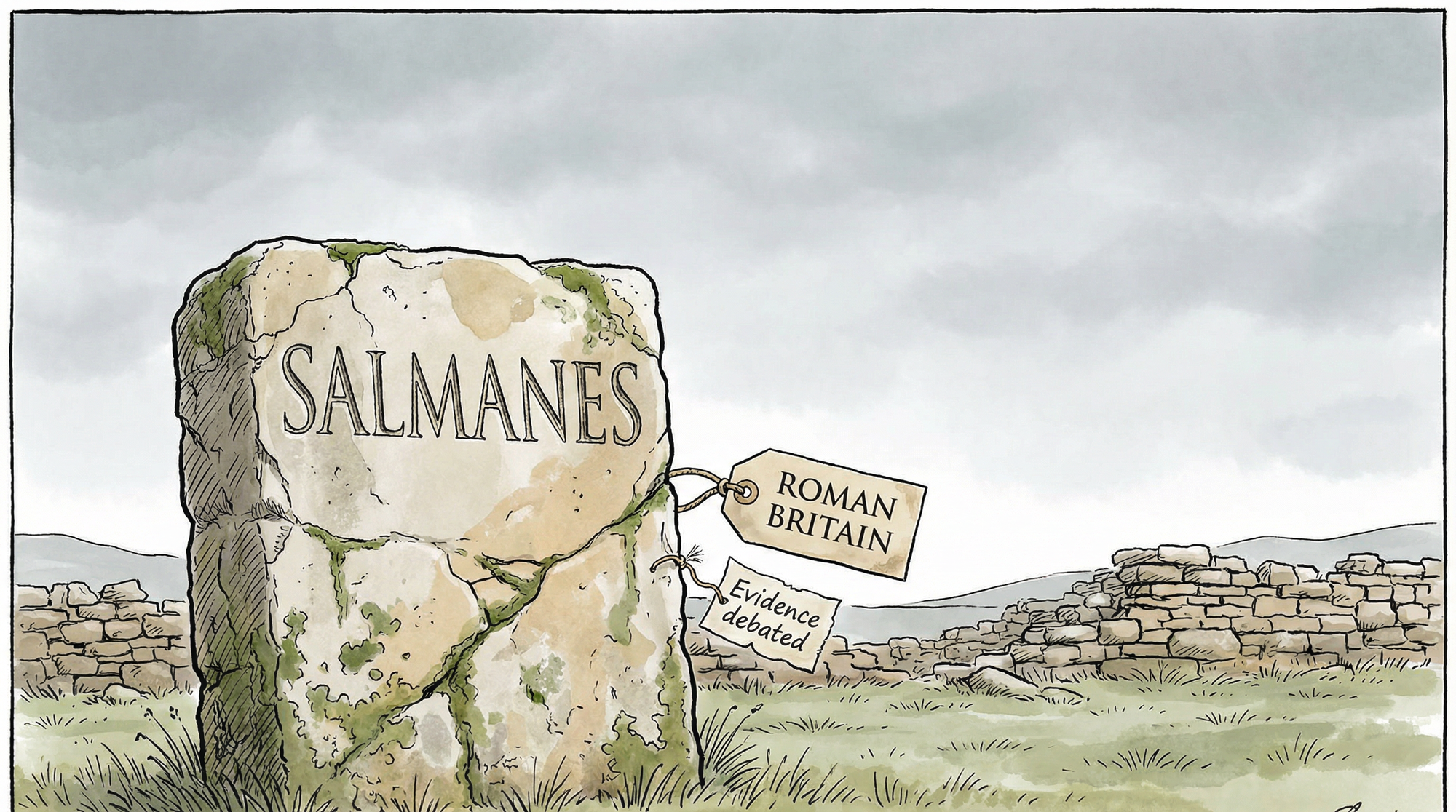
If you want a single object that disrupts the lazy assumption that “nothing Jewish touches Britain until the Middle Ages,” it is a small funerary inscription from Roman Scotland: RIB 2182, the tombstone of a boy named Salmanes, found at Auchendavy on the Antonine Wall.
On the face of it, this is an epitaph like many others. Yet the details matter. The standard scholarly entry notes plainly that “Salmanes” is a Semitic name, with currency in the Syrian region, and it has historically been taken to suggest the presence of “Eastern” people—sometimes imagined as traders—moving through or living within Roman Britain.
Now for the discipline. A Semitic name does not equal “Jewish.” It indicates geographic-cultural connections more easily than it indicates religious identity. If you push the stone too hard, you break your own argument.
But you also shouldn’t dismiss it because it isn’t a signed affidavit.
Meredith J. C. Warren uses this exact tombstone as a test case for a broader problem: the way “absence of evidence” gets treated as “evidence of absence” when it comes to Jews in antiquity. Her point is not that we can prove Salmanes was Jewish; her point is that the name should at least lead us to imagine the possibility, while acknowledging how difficult it is to assign iconography uniquely to one community.
That matters because it gives you a serious sentence you can say without bluffing:
“Roman Britain contains evidence of people with Near Eastern connections living and dying on this island; Jewish presence is plausible in specific cases, even when it cannot be proven beyond doubt from the surviving material record.”
That is not a dramatic reveal. It is something better: a correction to a modern habit of overconfidence.
Anglo-Saxon England: no documented Jewish settlement, but Israel everywhere you look
Here is where people tend to overreach—or undersell.
The overreach is to argue: “If Jews may have been in Roman Britain, then there must have been Jewish communities in Anglo-Saxon England too.” We cannot make that leap. The best scholarship is explicit: no reliable evidence of pre-1066 settlement or sustained contact in England.
The undersell is to say: “So the Anglo-Saxons had nothing to do with Jews.” That is also wrong, because it confuses the absence of a documented minority with the absence of a cultural relationship.
Conor O’Brien captures the reality in one sharp formulation: Jews were absent from England before the Norman Conquest “in reality,” but not absent “at the imaginative level,” where they played a substantial role in Anglo-Saxon culture.
“Imaginative” here does not mean fictional. It means textual and intellectual: sermons, biblical commentary, liturgy, poetry, and the thought-world of a society that reads the Hebrew Bible as scripture. Anglo-Saxon England did not have to meet Jews in the marketplace to be saturated in Israel’s story. Israel was already embedded in the Christian world they inherited.
And this is the crucial point for your argument: Israel was not treated as a curious foreign topic. It was treated as sacred foundation. For a people whose Christian identity was historically recent, Israel supplied antiquity, authority, and the deep past of God’s dealings with humanity.
What “reverence” looks like in Anglo-Saxon writing: victory, exemplars, and a sacred past treated as real
If you want to argue reverence, you cannot do it with mood music. You do it with texts.
Judith: “worthied by victory”
The Old English poem Judith is a retelling of a Jewish story in the language of heroic verse. The Israelites/Hebrews are not portrayed as contemptible. They are portrayed as brave, organised, and—crucially—helped by God.
One passage is almost too neat for the point it makes. The poem describes the kid pursuing force as “the army of the Hebrews, worthied by victory”, and then states: “The Lord God… helped them fairly.”
That is not neutral description. That is honour language. It frames Israel as a people whose courage and success are fit to be celebrated.
If you’re writing carefully, you can say it like this:
“Anglo-Saxon Christianity treated Israel’s past as sacred reality—an authoritative history through which the English understood the Church’s origins and God’s dealings with humanity.”
The honest boundary: what you can claim, and what you can’t
If your aim is to challenge the casual assumption that “Jews only arrive late,” you can do it—provided you keep your feet on the evidence.
You can responsibly say:
- Britain’s connection to Jewish presence may extend back into the Roman period, at least in the sense that Near Eastern individuals are attested, and some cases (like the Salmanes tombstone) make Jewish identification plausible even when it cannot be proven with certainty.
- England before 1066 does not provide reliable evidence of Jewish settlement or sustained contact, so it is wrong to invent an Anglo-Saxon Jewish community in the way later medieval England clearly had one.
- Anglo-Saxon culture nevertheless engaged deeply with Israel and “the Jews” through scripture, sometimes in strikingly admiring terms—portraying Hebrews as “worthied by victory,” holding up Jewish heroes, and treating Israel’s sacred history as the authoritative beginning of Christian meaning.
What you can say—cleanly, and with spine—is that the story is older and more textured than the usual timeline suggests: Britain has Roman-period hints and plausibilities; England has a clearly documented post-Conquest Jewish history; and Anglo-Saxon England, even without documented Jewish neighbours, treated Israel’s story as foundational, authoritative, and frequently heroic.
That is a serious argument. It doesn’t need embellishment. It just needs discipline.