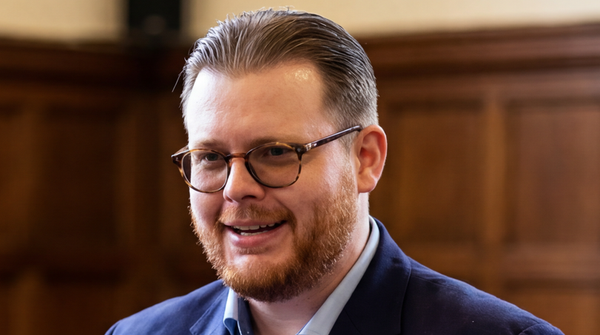

Two weeks ago, I released a video in which I disclosed my identity as Joshua Bonehill-Paine.
This was always something I intended to do. I had no wish to live in the shadows indefinitely. But I wanted to do it at the right time, and in the right way — not under pressure, not cornered, and not without recourse — because there are very real victims in my past, including high-profile politicians from the Jewish community. That fact is not incidental. It is central.
That said, concealment was never going to be a permanent strategy. The Crewkerne Gazette has grown at extraordinary speed and scale. It now reaches an audience so large that legacy satirical publications, however established, cannot simply ignore it. In that context, attempts to identify the people behind it were inevitable.
And so, eventually, I chose to speak first.
I published a 45-minute interview on the Crewkerne Gazette in which I disclosed my identity, explained the changes I have made, and stated clearly that I regret my past as an antisemite. I also addressed the work I later did in counter-extremism, confronting antisemitic hatred directly. I provided evidence of that work to journalists, including material that was acknowledged in subsequent reporting.
What followed has only reinforced why I wanted to do this on my own terms.
What was reported — and what was not
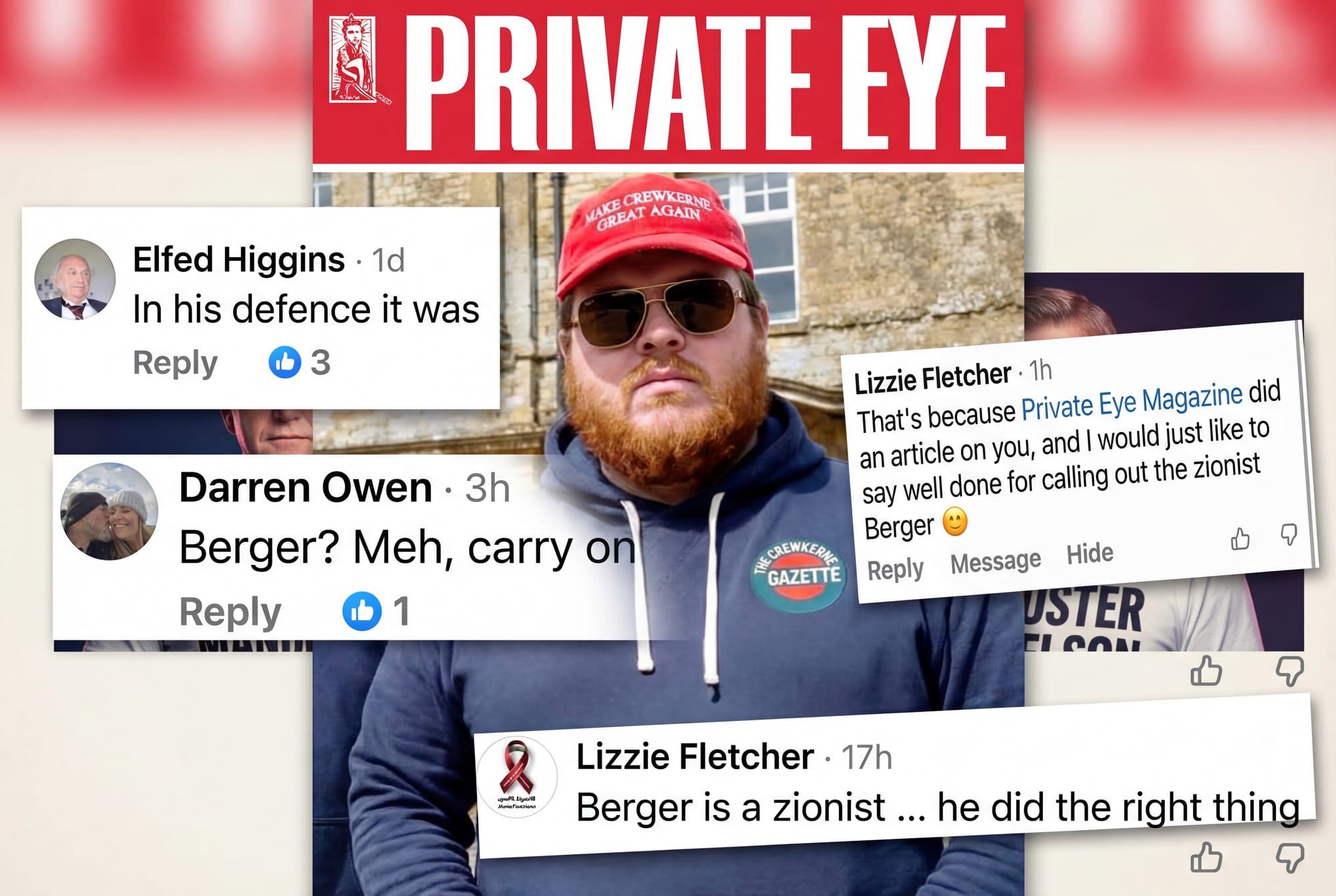
Private Eye took a dim view of my public disclosure and published an article about it. In my view, the piece contained serious inaccuracies, including claims about how and when my identity was denied, and a misleading presentation of events surrounding my decision to come forward.
In particular, the article stated that I had been contacted directly in December and had denied my identity. That is not true.
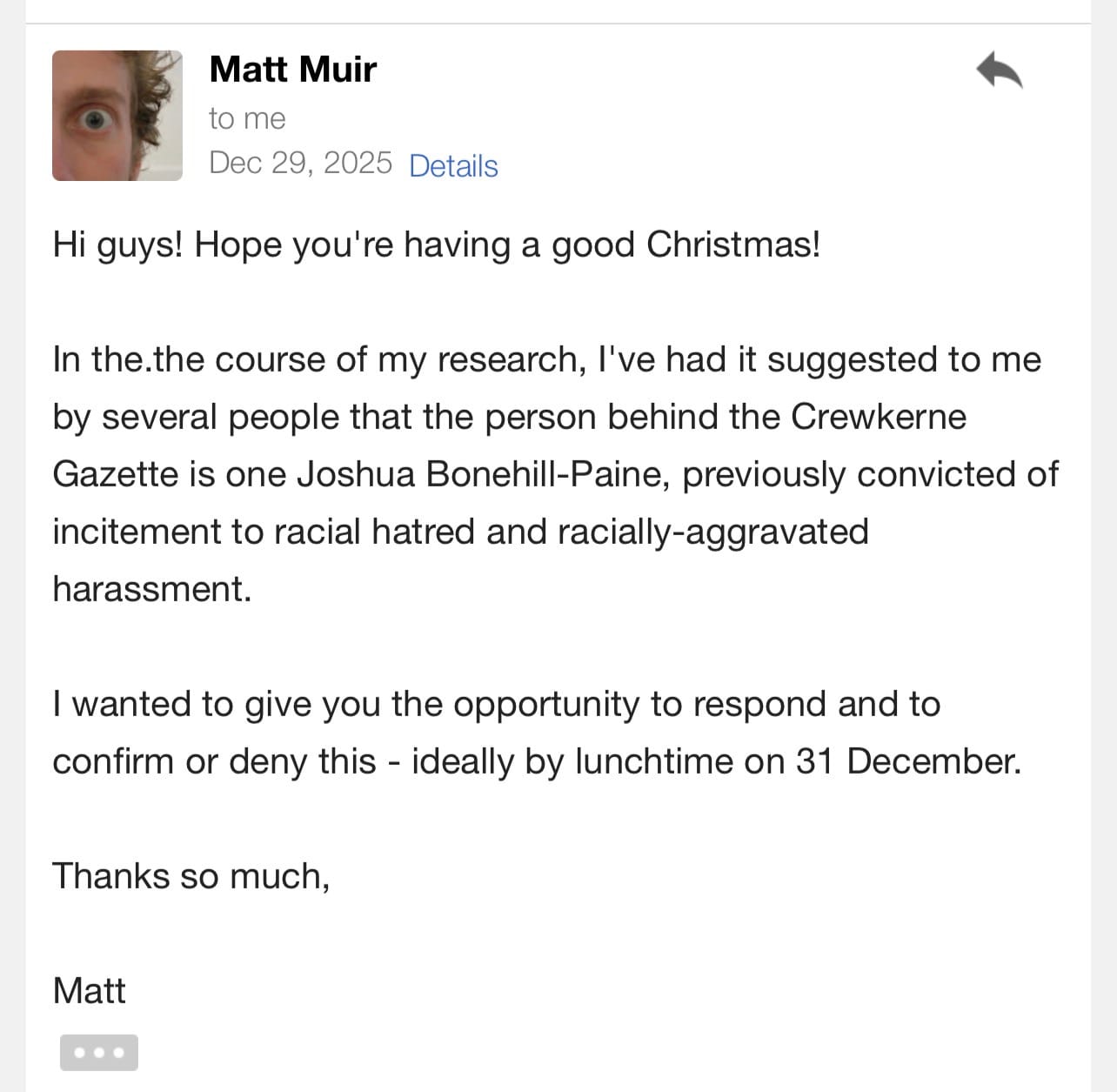
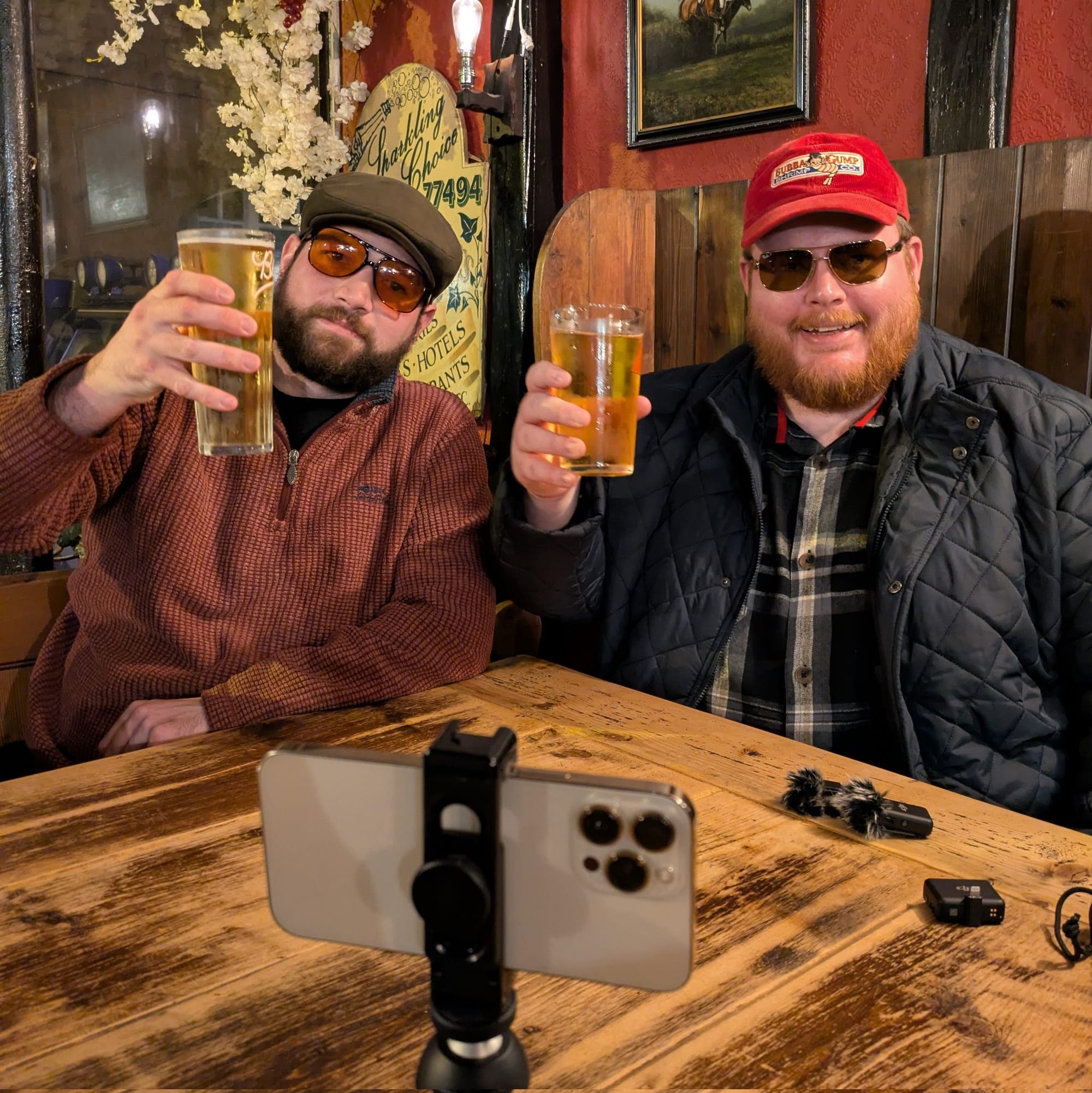
The contact was made to the Crewkerne Gazette and the person spoken to denied being me, Joshua Bonehill-Paine. That denial was not a lie from me to them; it was a denial by another party. As painful as it is to admit in a piece like this, I was not the original founder of the Crewkerne Gazette. I came in later. That distinction matters, and it was not reported properly.
Because of those inaccuracies, I have begun the process of taking legal action.
People can disagree with me. They can criticise me. They can write harshly about my past. I have no complaint about scrutiny. But if you are going to publish serious allegations and factual claims, they still have to be true.
The part that disgusted me most
The worst part was not the article itself. It was what followed.
I was disgusted to see the reporting present me in a way that painted me as if I were a current, practising antisemite. That framing did not simply generate criticism. It generated threats, harassment, and — most grotesquely — an influx of antisemites who treated the coverage as an invitation.
Some of them openly praised what I had done in the past.
Some excused my past antisemitism on political grounds.
And in the comments under coverage on social media, some went further still and targeted one of my former victims. That, more than anything else, turned my stomach. It is one thing for people to abuse me. It is another to use a contemporary media story as a springboard to revive abuse against somebody I harmed in the past.
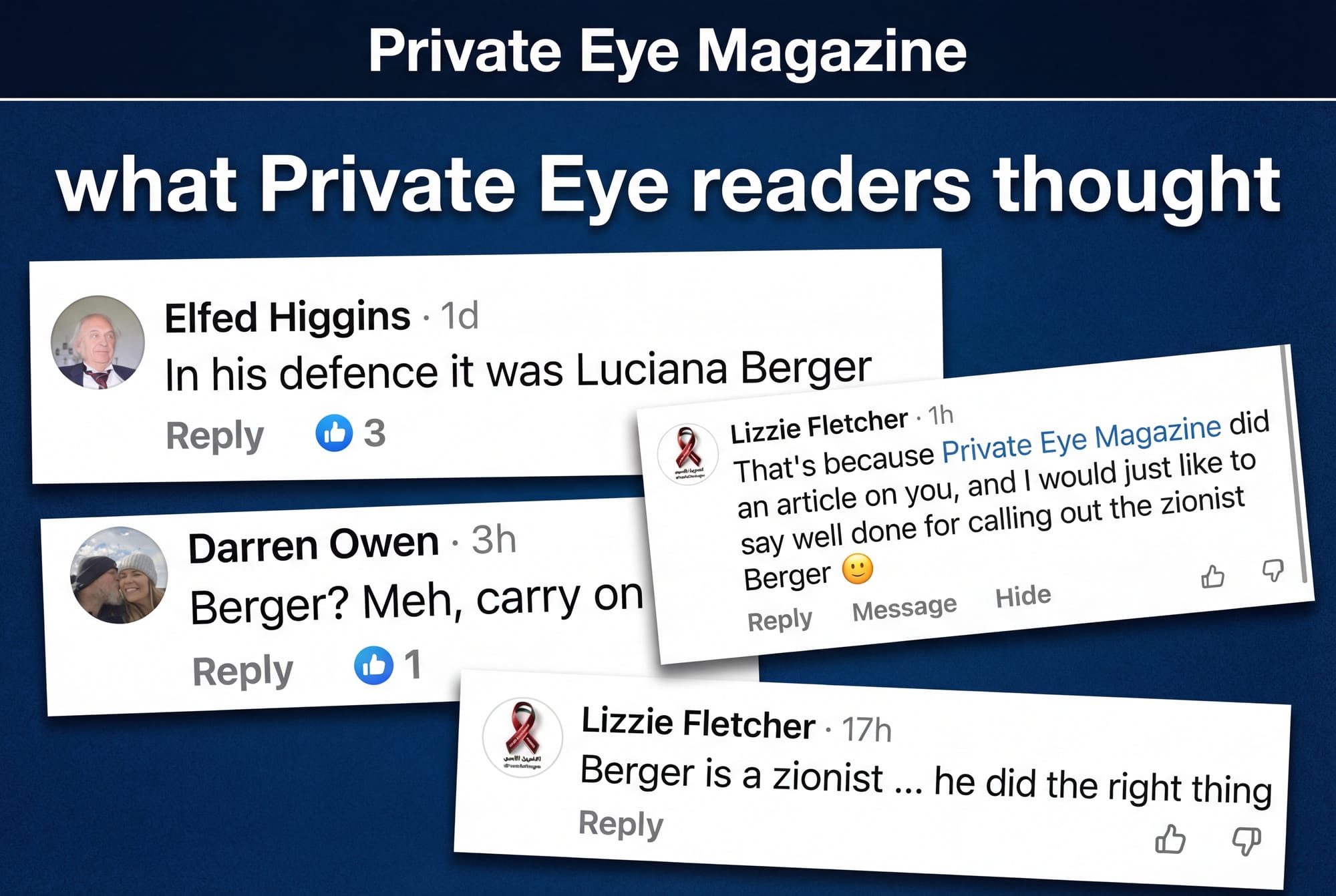
That is not commentary. It is antisemitism.
And it revealed something ugly but important about the current moment: there are people — including people who consider themselves on the political left — who are perfectly willing to excuse or even applaud antisemitism when they think it is aimed at the “right” kind of Jew, or when they can dress it up as anti-Zionism. This is not a fringe misunderstanding. It is a real and growing moral failure.
Several of these people then appeared on the Crewkerne Gazette page, seemingly expecting a warm reception, as if my past placed me in ideological solidarity with them. It does not. It hasn’t for a long time.
They arrived because they had not been told — or chose not to hear — that I rejected antisemitism years ago, and that I spent longer working against hatred than I ever spent immersed in it.
The Channel 4 coverage and Baroness Berger
A similar response followed the Channel 4 reporting. Again, antisemites surfaced to applaud my past, as though I should somehow be pleased by their approval. I was not. I found it revolting.
What I also found deeply troubling was the way Baroness Berger was approached and informed.
I bitterly regret how I treated Luciana Berger. What I did was relentless and wrong. I have not contacted her directly to apologise, not because I do not want to, but because I do not know whether that would be wanted, welcome, or fair. To be blunt, I am ashamed — and I am cautious. Any apology, if it were ever to happen, should be handled through appropriate intermediaries so that she has full control over whether she wishes to receive it.
You have to remember what that period was like. It was not just me. She was subjected to a torrent of antisemitic abuse and threats from many people. That context matters. So to approach her in Parliament and effectively spring this news on her without reassurance or care struck me as deeply insensitive.
When journalists deal with stories like this, they are not handling abstract “content.” They are dealing with real people and old wounds.
Regret is easy to say. Change is harder to prove.
One of the oddities of British public life is that we often claim to believe in rehabilitation until somebody inconvenient asks for it.
Matthew Collins of Hope Not Hate is a useful comparison, not because our stories are identical, but because the principle is the same. He was once deeply involved in violent extremism and later became widely recognised for anti-extremism work. He was given the space to change and to be judged, at least in part, by what he did afterwards.
I have shown regret for my past views, but I did not stop at saying sorry to myself in private.
I worked in counter-extremism. I passed Prevent-related training. I received Home Office certificates. I spoke to large audiences. I worked with institutions. At times, I was able to help young people expressing antisemitic views understand why those views were wrong and to move away from them. I did not do that work for applause, and I did not do it for money. I did it because it was right.
That does not erase what I did before. It does not erase the victims. It does not erase the damage. But it does matter.
If we are serious about reducing antisemitism and extremism, then stories of genuine change are not embarrassments to be buried. They are tools. They are warnings. They are evidence that people can be pulled back before hatred becomes a lifetime.
Politics, prison, and what actually changed me
Part of the recent coverage also tried to pin my present politics down in ways that were either simplistic or just wrong.
Channel 4 was keen to present me as a supporter of Reform. That was based on something I said being taken out of context and presented as fact. The reality is that my personal politics are Conservative, and I recently renewed my membership.
That matters here because my rehabilitation did not happen in a vacuum. It happened within institutions — including prison — that were, at least in my case, capable of facilitating change.
I have spoken before about the importance of rehabilitation in prison, and about how a prison system that takes reform seriously can make a difference. But the environment is only part of it. Rehabilitation also depends on the individual. You have to want to change. You have to decide that the person you have become is not the person you are willing to remain.
The system can create conditions. It cannot manufacture conscience.
Michael Gove, prison, and the possibility of change
It is also worth saying something plainly that many people on my side of the story are not expected to say: prison did not simply punish me. In my case, it helped change me.
That matters, because there is a lazy assumption in public life that prison is either vengeance or failure. It can be both, of course. But it can also be something else: a place where rehabilitation is taken seriously enough that a man who has done terrible things is forced to confront what he has become.
I have often thought about this in relation to Michael Gove’s period overseeing prison reform. Gove was explicit that the purpose of prison was not only custody but rehabilitation — that prisons should help people leave as changed characters and reduce reoffending. In my case, whatever institutional continuity remained after his time in office, that principle worked.
“The principal purpose of prison is rehabilitation”
That does not mean prison “fixed” me in some automatic sense. Rehabilitation is not a conveyor belt. The individual has to want it. You have to make a decision first — to abandon the lies, the grievance, the self-justification. But the environment matters too. If the system gives you no route back, many people will not find one. If it creates the conditions for reform, some will.
I am one of them.
And that is not a left-wing point or a right-wing point. It is, in the best sense, a conservative one: people are responsible for what they do, but they are not beyond the possibility of moral change.
“Prisons should help people leave as changed characters and reduce reoffending”
What this says about Britain now
We are living through a period in which antisemitism is becoming dangerously normalised again. I hate writing that sentence, but it is true.
It appears in old forms and new forms. It appears on the far right and on parts of the left. It appears in conspiracy culture, in activist culture, in comment sections, in coded language, and in not-so-coded language. And increasingly, it appears wearing the mask of moral seriousness.
That is why I believe stories like mine should be told properly.
Not because I deserve praise. Not because I am owed absolution. But because if somebody can move from antisemitism into anti-extremism work, that fact is useful. It may help deter somebody now standing where I once stood. It may help a parent, a teacher, or a professional recognise the warning signs. It may help puncture the fantasy that extremism is a one-way road.
Instead, what I saw in some coverage was something closer to sensationalism: a flattening of the story that stripped out the change and left only the old crime, as though there were no difference between a current antisemite and a former one who now opposes those views. That flattening is not just lazy. In the current climate, it is dangerous.
Because when you blur that distinction, you do not merely “hold someone accountable.” You can end up directing active antisemites towards a story they interpret as validation.
I no longer hold those views. I reject them completely. I regret them bitterly.
But the reaction to this story has shown me something I already suspected: Britain is in a far darker place on antisemitism than many people want to admit, and the people fuelling it do not all look the way we expect.