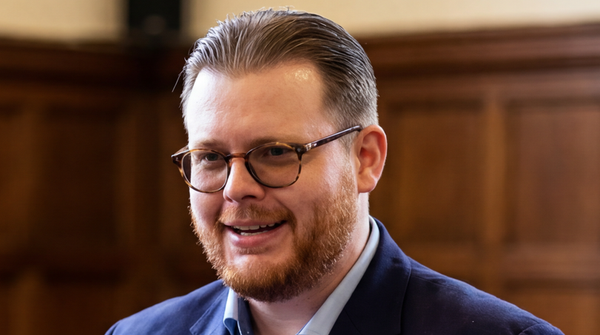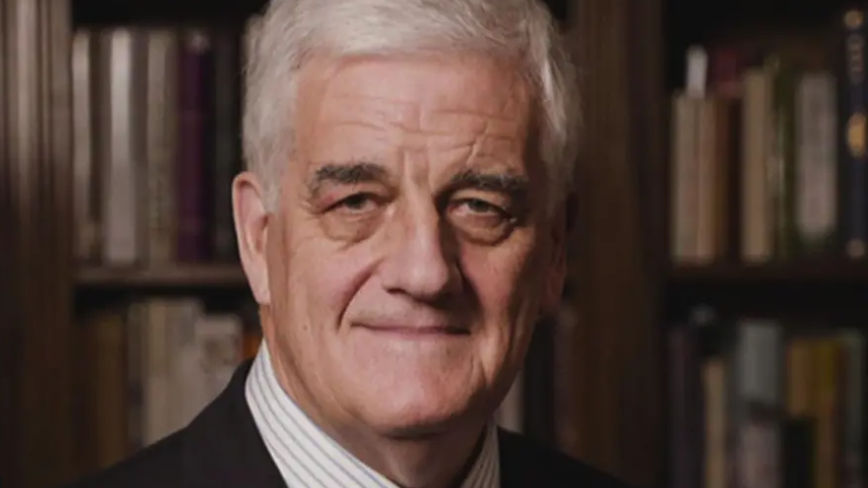

There are moments in public life when one is given no comfortable option. One may remain silent, preserve relationships, and avoid unpleasantness — or one may say what must be said, knowing full well that it will displease allies and delight enemies. This week, I found myself in precisely that position.
Let me begin with what ought to be said first, and said unambiguously. Rear Admiral Chris Parry is a man who served his country with distinction. He is a Falklands veteran, a man mentioned in despatches, and one later honoured with a CBE. He belongs to that diminishing generation of public figures whose service was not theoretical, performative, or conducted from the safety of a television studio, but real. That matters. It matters to me, and it ought to matter to the country.
Which is why what followed was all the more dismaying.
In the immediate aftermath of the attacks on Hatzolah ambulances in London — at a time when antisemitic agitation was already spreading rapidly online — Dr Parry reposted a message from Catherine Blaiklock which, in my judgment, helped to cast suspicion upon the Shomrim, the Jewish neighbourhood watch groups operating in Stamford Hill and Golders Green. Worse still, he appeared to refer to them as “cosplayers”, a sneering phrase which did not merely trivialise what they do, but seemed to join in with a very old and very ugly line of insinuation.
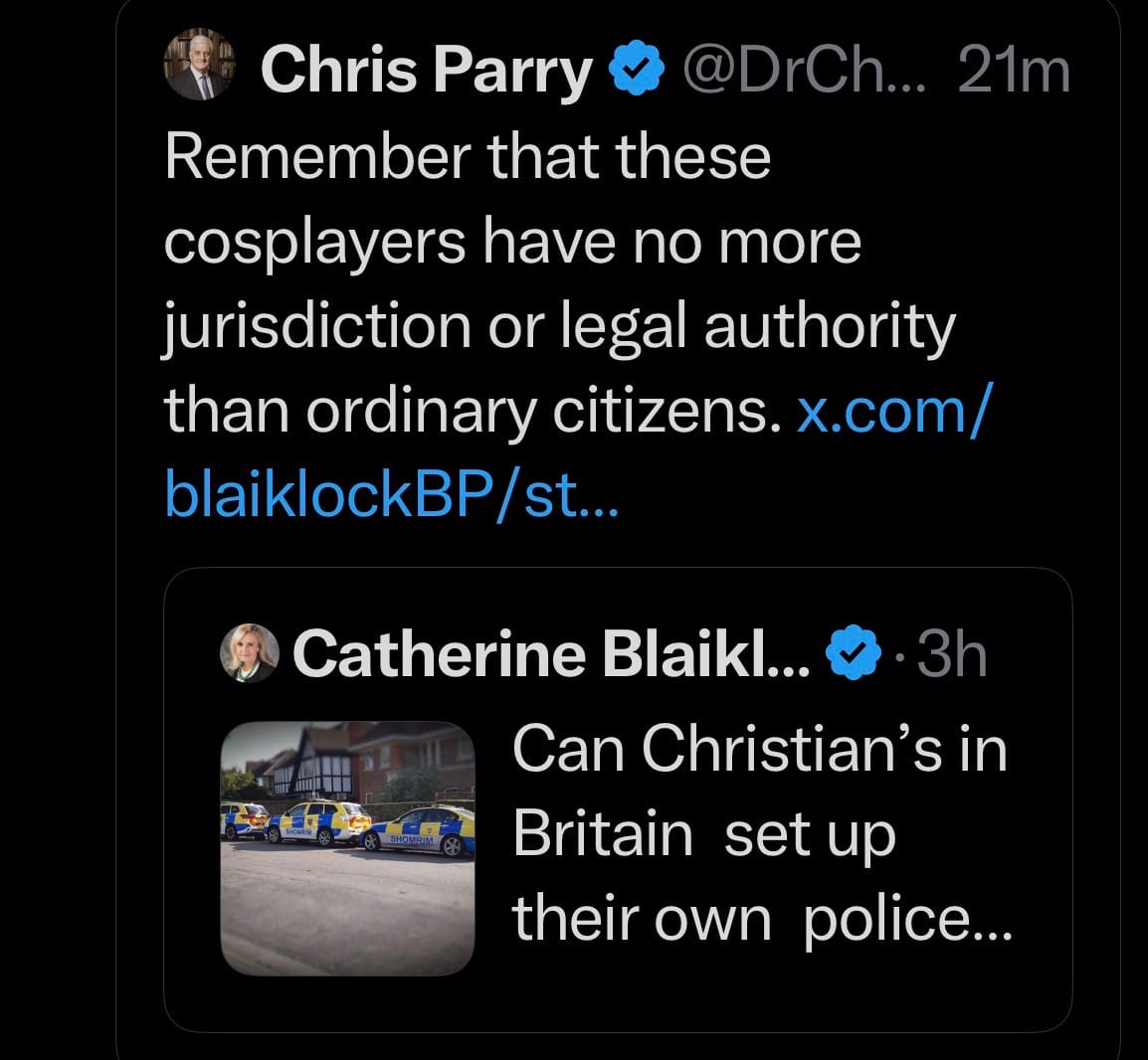
That insinuation is a familiar one: suggest that the Shomrim are not a community safety organisation but some kind of parallel “Jewish police”; encourage others to see them not as citizens protecting their own streets, but as something alien, suspect, and faintly threatening. One does not need to be a scholar of antisemitism to recognise the shape of that rhetoric. But I recognised it with particular clarity because, shamefully, I once trafficked in it myself.
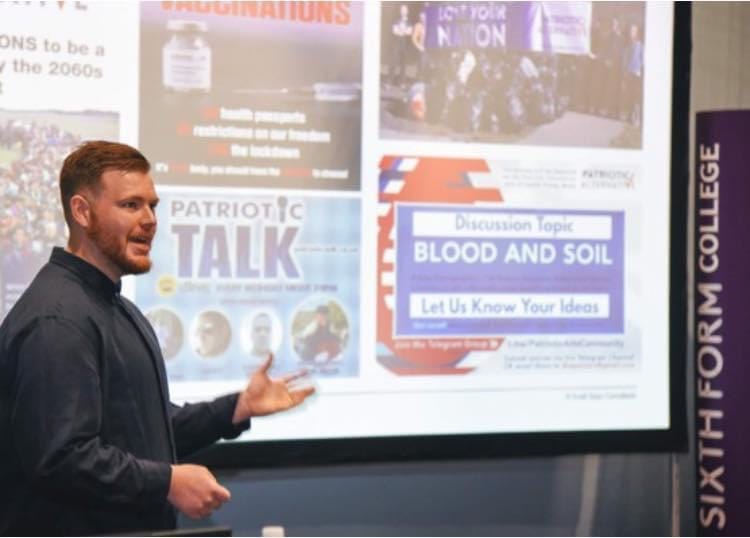
More than a decade ago, I was one of those who promoted this sort of poison. I attacked the Shomrim. I falsely presented them as a law-enforcement body. I used language intended to stir resentment and ethnic hostility. I coined terms, produced grotesque racist material, and did what antisemites so often do: I took something ordinary and civic — neighbours protecting neighbours — and presented it as evidence of sinister Jewish encroachment. I was arrested, convicted, and imprisoned. I deserved to be.
What prison gives a man, if he allows it to, is time: time to strip away the slogans, the tribalism, the vanity, the self-deception. Time to see, with dreadful clarity, that one was not “raising concerns” or “asking questions”, but spreading filth. Time to understand that what one thought was political courage was in fact moral cowardice. And time, if one is fortunate, to resolve never again to lend one’s voice to the old hatreds.
That is why I could not simply shrug when I saw Chris Parry’s repost and his remark. I knew where that line of argument leads because I had once walked further down it than most. I knew, too, that this was no ordinary moment. Britain’s Jewish community is living under extraordinary pressure. Synagogues have been attacked. Jewish institutions have required ever-greater protection. Jewish people have faced intimidation, harassment, and violence. And now even Hatzolah — volunteer ambulance crews, men literally trying to save life — had been targeted. At such a moment, to indulge even carelessly in language that fuels suspicion of Jewish community groups is not a trivial lapse. It is a grave error.
So I challenged him publicly. The post was deleted. Then came the familiar attempt at retreat: the suggestion that the plain meaning of the remark was not really its meaning at all; that the words did not bear the implication they self-evidently bore; that everyone else had somehow misunderstood. Fortunately, I had taken a screenshot before deletion.
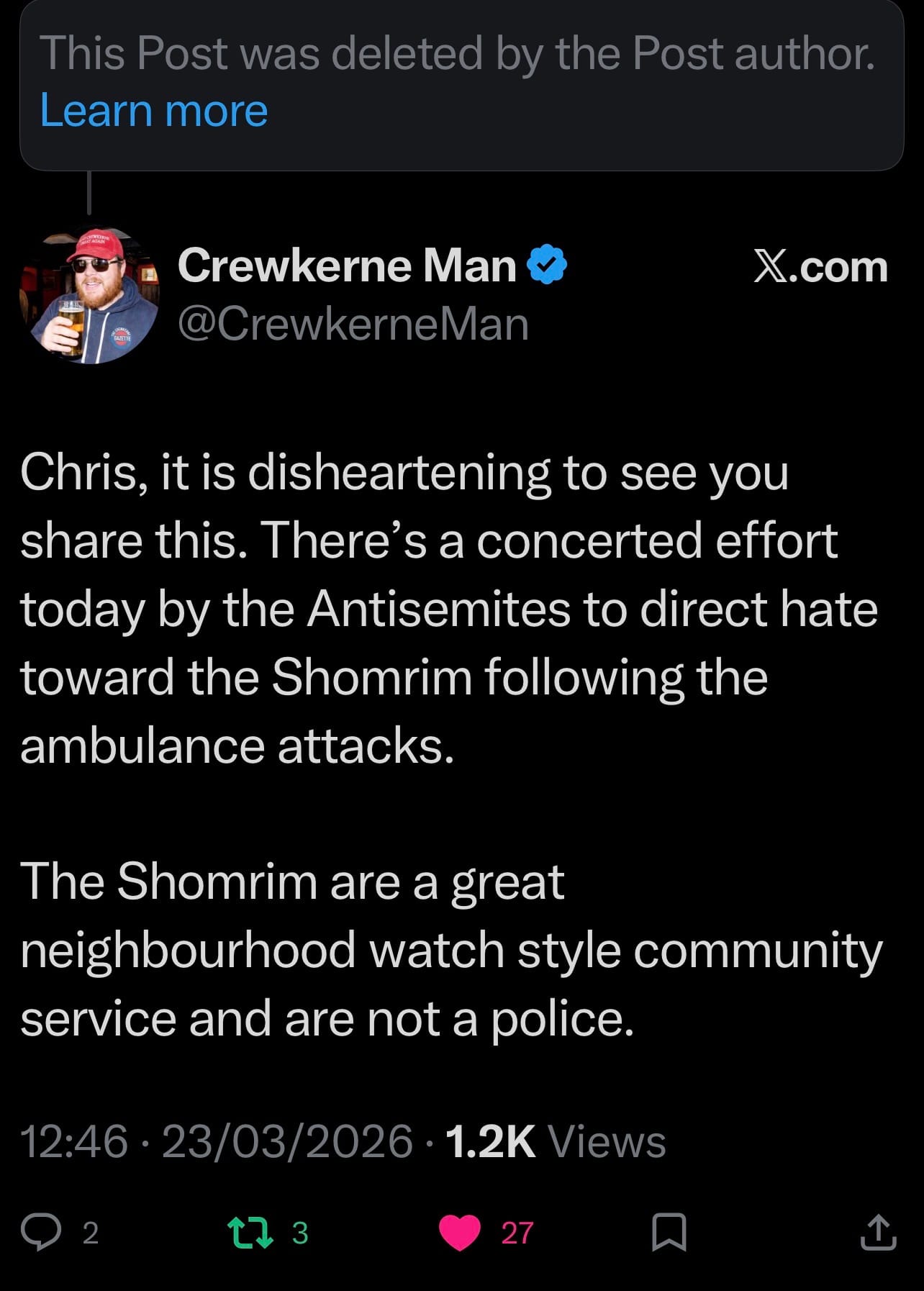
I take no delight in any of this. I did not expose Chris Parry because I wished to destroy him, nor because I enjoy internecine bloodsport on the Right. Quite the reverse. It gives me no pleasure whatsoever to have had any hand in bringing difficulty upon a man whose military service I respect. But there are times when previous experience imposes a duty. If one has once helped spread a lie, one incurs a particular responsibility to challenge it when it reappears — especially when others, through naivety or sentimentality, are tempted to wave it away.
The irony, of course, is that only days earlier The Guardian had sought to make me the story, attacking both me and Dame Rebecca Harris for something as absurd as the sharing of satirical content. The same liberal press which affects endless concern about extremism has shown remarkably little interest in the reality of moral rehabilitation when it occurs in a direction they do not like. They are happy to say that people can change, provided they change into something fashionable. They are far less happy when a former extremist becomes a conservative, joins the Conservative Party, works in counter-extremism, and begins speaking up robustly for Britain’s Jews.
Channel 4 has taken a similar interest in insinuation over substance. One is invited to remain, forever, what one once was — particularly if one now embarrasses the progressive consensus. Yet the truth is plain enough. I have spent longer opposing extremism than I ever spent embracing it. I do not support antisemitism of the Right, the Left, the Islamist variety, or the fashionable “anti-Zionist” kind dressed up for polite society. I oppose it because I know what it is.
And that is precisely why this episode matters beyond the fate of one retired admiral or one Reform figure. It concerns whether we still possess the moral seriousness to identify antisemitic narratives when they are politically inconvenient. It concerns whether public figures on the Right are prepared to understand that the defence of Britain’s Jews is not an optional extra, not a tactical accessory, and not a matter to be subordinated to culture-war reflexes or lazy online punditry. It is a test of seriousness.
This is where the Conservatives, at their best, still have an advantage. For all the party’s many mistakes over the years, serious Conservatives understand something that large parts of the modern political class have forgotten: that a nation is held together not merely by economics or institutions, but by moral loyalties. Among those loyalties must be an absolute and instinctive solidarity with a Jewish community under pressure. Not because such solidarity is fashionable — it often is not — but because it is right. Because patriotism, if it means anything, means defending one’s fellow citizens when they are singled out, smeared, attacked, or made to feel like strangers in their own country.
The Conservative instinct, in its healthiest form, is not to sneer at institutions of communal responsibility such as the Shomrim, but to admire them. They are not a “parallel police force”. They are not some exotic aberration. They are citizens exercising vigilance, public spirit, and communal duty. They belong to the same moral landscape as the church volunteer, the street pastor, the parish organiser, the retired soldier helping at the local memorial hall — all those little platoons which a healthy nation should cherish rather than malign.
By contrast, much of the contemporary Left has proved itself incapable of speaking with equal clarity. Too often it equivocates, relativises, explains away, or simply goes missing when Jews are targeted. Too often it finds its voice only when the offender is safely right-wing. Too often it treats antisemitism as a partisan inconvenience rather than a civilisational disgrace. The result is a political culture in which British Jews are asked, again and again, to wait while others decide whether their fear is sufficiently useful to merit attention.
That is intolerable.
It should not require a former antisemite to point any of this out. But perhaps there is some grim appropriateness in it. Those of us who once contributed to the rot have obligations that others do not. We know the syntax of hatred. We know the evasions, the coded language, the “just asking questions”, the feigned innocence, the sly effort to make Jews appear tribal, over-powerful, or separate. We know how quickly a supposedly minor remark can serve as a permission slip for uglier men.
So yes, I spoke up. I would do so again. Not because I wished to injure Chris Parry, but because there are occasions when silence itself becomes a form of acquiescence. Britain is passing through a dangerous moment. Iran’s proxies, Islamist extremism, street-level antisemitism, and elite cowardice have combined to place the Jewish community under a level of pressure no decent society should tolerate. In such a climate, every public figure has a duty to exercise care. Those who fail in that duty must expect to be challenged.
Rear Admiral Parry’s service should be respected. His record should be acknowledged. But that cannot place him beyond criticism. No decoration, however deserved, can confer immunity from moral error.
The essential point is a simple one. Antisemitism is evil wherever it appears. It does not become less ugly when expressed clumsily rather than systematically, nor less dangerous when voiced by someone decorated rather than disreputable. We either oppose it in principle, or we do not oppose it at all.
For my part, having once been on the wrong side of that line, I have no intention of crossing back.