
There are parts of my story I have never really spoken about. This is one of them, and it is not something I remember with any pride.
During the first year or so of my prison sentence, in 2015 and 2016, I was sometimes housed alongside radical Islamists. Some openly expressed support for ISIS. Given what I believed at the time, you might imagine that we would have been natural enemies.
In many respects we were. But there was one subject capable of crossing that divide: antisemitism.
I remember it particularly clearly from the prison webbing shop. We spent our days making netting, including netting for the British Army. There was already a dark irony in men sympathetic to ISIS manufacturing equipment for British soldiers.
Looking back, there was another irony too.
We spent our days making webs while constructing imaginary ones in our heads.
When I first entered the workshop, some of the Islamist prisoners approached me aggressively.
“You’re that racist who hates Muslims, innit?”
I told them they had the wrong person and said they were thinking of Tommy Robinson. I explained that I had actually been sent to prison for antisemitism.
The atmosphere changed.
Suddenly I was acceptable enough to sit at their table. I believe my antisemitism may even have saved me from being attacked that day. That is an extraordinary and deeply uncomfortable sentence for me to write now, but it illustrates the point better than almost anything else I can say.
The webbing table became our meeting place.
We would sit there for hours making nets while talking about politics, religion and the world outside. Antisemitism came up again and again. So did conspiracies involving Jews, the Rothschild family, finance, governments and supposed hidden networks of power.
We had, in a sense, created another web on that table.
We would take an event, a name or something somebody had read and connect it to something else. Another person would add another supposed connection. Before long, isolated facts, coincidences and outright nonsense could be woven together into something that appeared meaningful to people who already wanted to believe it.

I participated in those conversations. Sometimes I spoke at length to the men around that table. Sometimes I listened. Sometimes we would spend large parts of the working day examining these supposed connections.
I feel disgusted remembering it now.
There is nothing clever or courageous about sitting around inventing theories about Jewish people. I am ashamed that I once helped spread precisely the sort of hatred I now spend my time arguing against. Jewish people were not characters in some intellectual puzzle for us to solve. They were real people upon whom we were projecting suspicion, resentment and conspiracy.
I include these details not because I want to sensationalise that period of my life, and certainly not because I want to repeat the conspiracies themselves. I include them because understanding how antisemitism works requires being honest about how people become absorbed by it.
At that table, conspiracy thinking was social.
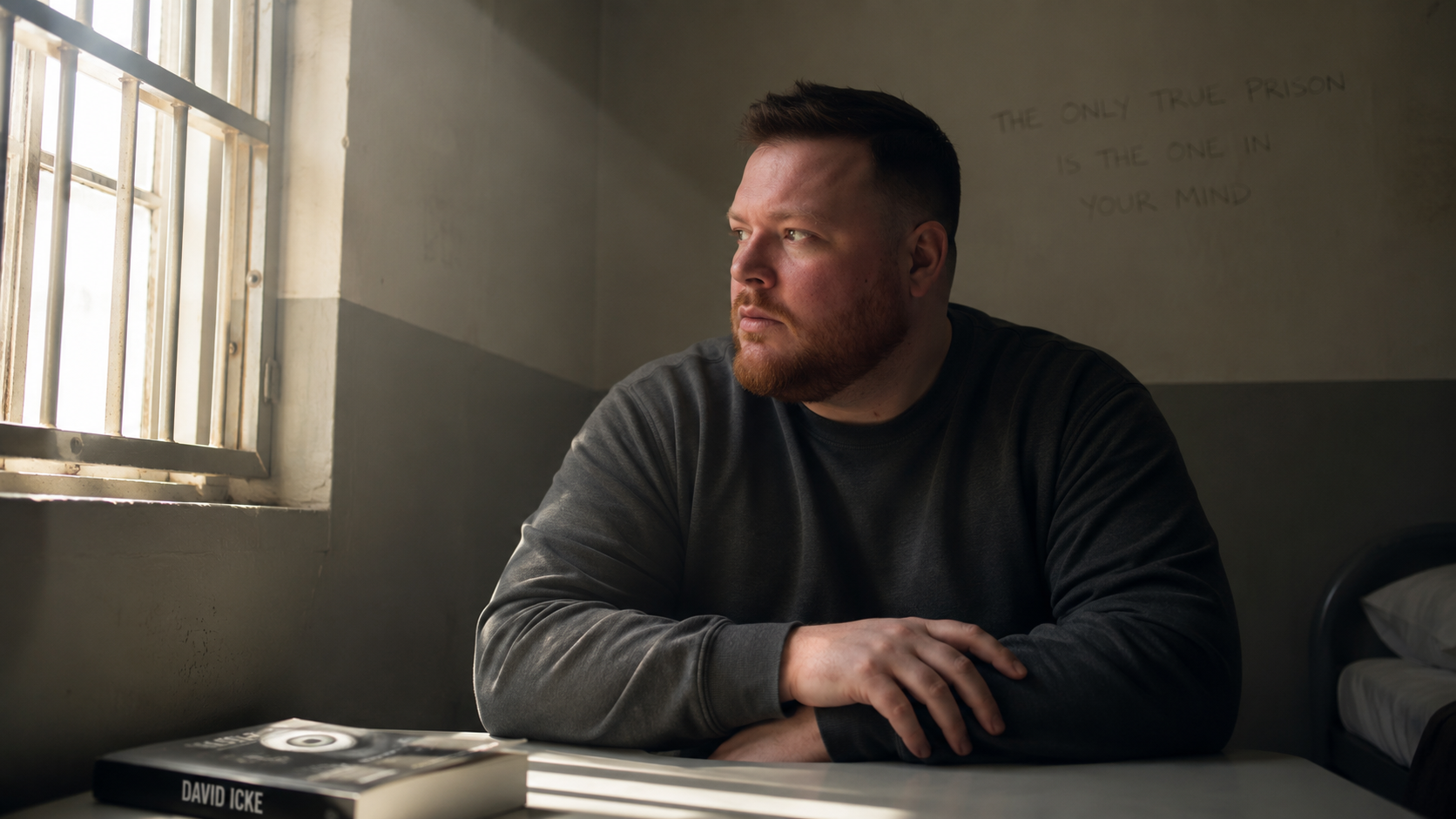
Books moved around the prison too. David Icke’s books were commonplace and there was an informal culture of lending books between prisoners. Material about hidden forces and secret networks fitted easily into the conversations already taking place.
Looking back, I can see the attraction such material had to an extremist mind. It offered patterns everywhere. Nothing was accidental. Every event could supposedly be connected to another. Every complicated problem could be reduced to somebody secretly causing it.
And once you begin with antisemitic assumptions, it isn’t difficult to guess where that imaginary web eventually leads.
I am ashamed that I once found any of this persuasive. But pretending I never did would make everything I have learned from leaving antisemitism behind considerably less useful.
There was another remarkable thing happening around that table.
Some of the Islamist prisoners were trying to persuade me to read the Quran and study Islam. I wasn’t an Islamist. They weren’t from my political tradition. On plenty of subjects our beliefs were irreconcilable.
Yet there we were, sitting around the same table.
Antisemitism had done something that our politics could not: it had given us common ground.
That experience has returned to my mind repeatedly in recent years because the webbing table no longer seems quite as remote from modern Britain as it once did.
In May this year, Parliament’s Home Affairs Committee heard evidence on antisemitism that sounded remarkably familiar to me. Russell Langer of the Jewish Leadership Council described antisemitism as a common factor running through different forms of extremism, including Islamism, the far left, the far right, incel-related extremism and conspiracy movements.
I had watched a version of that happen around a prison table a decade earlier.
The difference is that today you don’t need the table.
You have the internet.
The internet has created millions of webbing tables.
People who would never attend the same political meeting, worship in the same place or vote for the same party can now find themselves in the same online spaces. One person supplies a conspiracy. Somebody else adds a screenshot. Another draws a connection. Someone produces a name, a photograph or a world event that supposedly proves everything.
A web begins to form.
CST recorded 680 online antisemitic incidents in Britain during the first half of 2026, its highest January-to-June figure. In 86 per cent of those cases, CST identified political or ideological discourse, antisemitic tropes or conspiracy theories.
And this week The Times reported leaked messages from a private group called Greens Against Imperialism in which participants allegedly discussed “killing Zionists”, made claims concerning British Jews and, in one case, praised Iran’s Islamic Revolutionary Guard Corps as part of a supposed liberation movement.
That does not mean the far left, far right and Islamists are one movement. They plainly are not.
It means something more complicated.
Ideas can travel where organisations cannot.
The Islamist prisoners around my table did not have to become far-right activists, and I did not have to become an Islamist, for antisemitism to provide common ground between us. The rest of our worldviews could remain completely different.
That is what worries me about what we increasingly see online.
Different groups can arrive at hatred of Jews by completely different routes. One might begin with racial nationalism, another revolutionary politics, another religious extremism and another with conspiracy theories. They don’t have to agree about how the world should work. They only have to agree about whom they blame for it.
And Jewish people are left facing the consequences.
That is the part that should never become lost in an academic discussion about extremism. Antisemitism isn’t interesting because extremists sometimes share it. It is dangerous because Jewish men, women and children have to live with what happens when they do.
My own history makes that painfully personal for me. I was an antisemite. I contributed to that hatred. I deeply regret the harm I caused, and I have taken antisemitism seriously for years precisely because I understand something about the road down which those ideas can lead.
The webbing shop also leaves me with a question about prisons.
We understandably worry about an Islamist radicalising another Muslim prisoner, or a far-right extremist recruiting somebody susceptible to his politics. But my experience suggests we should also be thinking about cross-pollination between people who apparently belong to opposing extremes.
What happens when they discover the things they agree about?
Our conversations weren’t organised extremist meetings. Nobody booked the room. Nobody published an agenda. We were simply prisoners sitting beside one another for hours every day, working, swapping books and talking.
That was enough.
Today an algorithm can assemble the table for you.
It can bring together people who have never met, who disagree about almost everything and who might even despise one another, yet who repeatedly encounter the same conspiracies about Jews.
Then the same process begins.
A claim becomes a connection. A connection becomes a pattern. A pattern becomes a web. And eventually the person staring at it becomes convinced that the web must be real.
I know it isn’t.
I know because I once helped weave one.
That is something I will always be ashamed of. But it is also why I believe we have to understand how these ideas move between people if we are serious about defeating them.
Ten years ago, mine was a physical webbing table inside a prison workshop.
Today there are millions of them in people’s pockets.
And wherever antisemitism provides the thread connecting those different worlds, it is Jewish people who are placed in danger.