
The old fantasy that antisemitism belongs only to one tribe of politics is collapsing. In the campaign against Shomrim, the extreme Right and extreme Left are now borrowing from one another’s script.
There are moments in politics when a single repost reveals more than a hundred speeches. Chris Williamson’s decision to amplify Jayda Fransen’s attack on Shomrim is one of those moments. Williamson is not some anonymous crank from the online swamp. He is a former Labour MP for Derby North, who served in Parliament from 2010 to 2015 and again from 2017 until 2019. He now sits not in Labour’s old broad church, but in George Galloway’s Workers Party of Britain, whose own website lists him as one of the party’s deputy leaders.
“Once the far Left begins sharing the far Right’s script about Jewish institutions, the pretence that this is merely anti-Zionism collapses.”
That background matters, because this is not merely a story about Jayda Fransen being Jayda Fransen. It is about a former Labour parliamentarian, long associated with the hard Left, lending his reach to material designed to cast a Jewish community safety group as somehow illicit, sinister, or beyond the law.
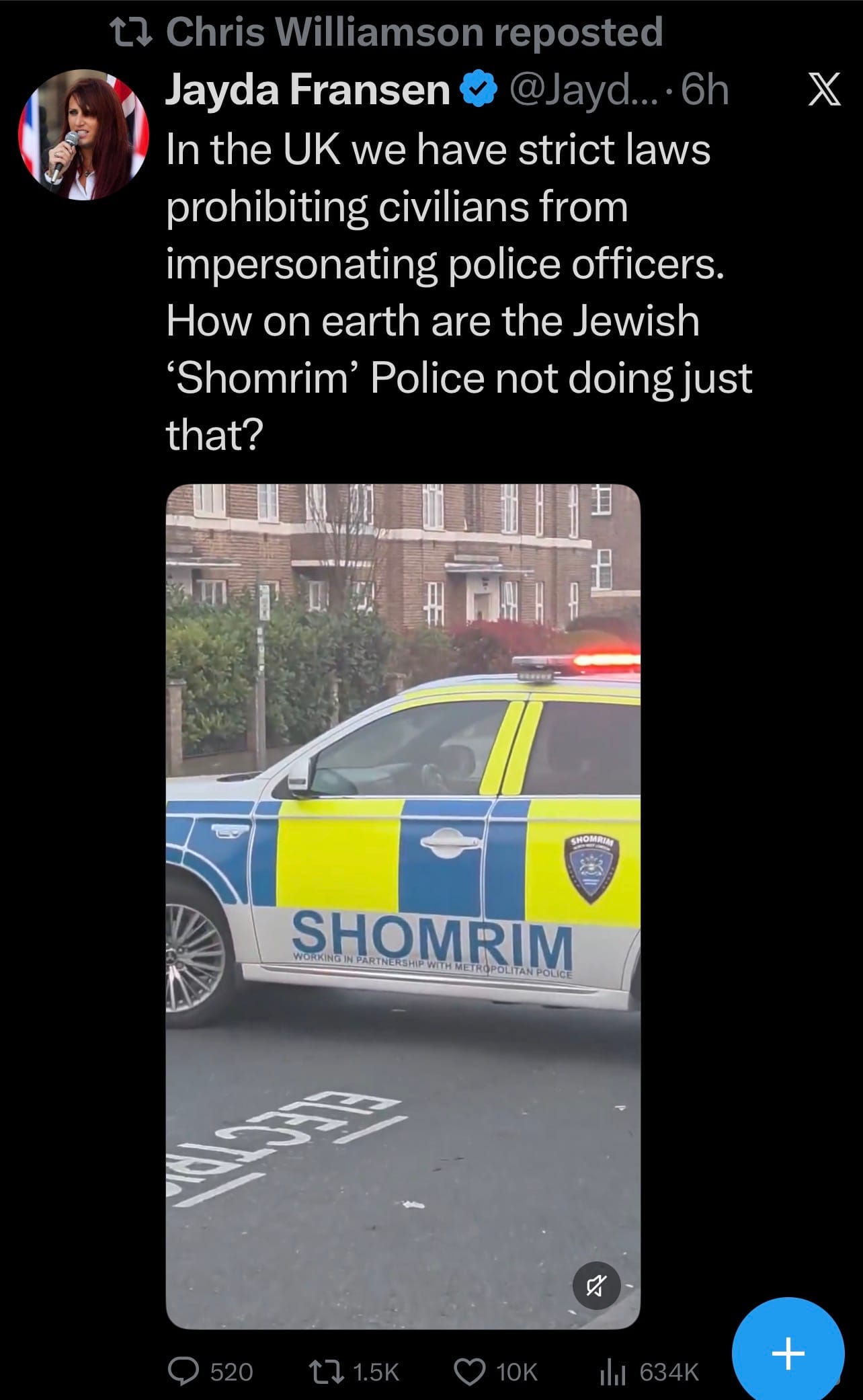
In the screenshot before us, Williamson reposts Fransen asking how the Jewish “Shomrim Police” are not unlawfully impersonating officers. The wording is not accidental. It does not ask a neutral question about volunteer patrols, branding, or community liaison. It invites suspicion towards a specifically Jewish organisation by suggesting that Jews are operating a parallel police force in Britain.
That allegation collapses the moment one looks at the facts. Shomrim London describes itself as a charity-backed community patrol whose purpose is to help reduce crime, act as a mobile neighbourhood watch, and observe and report incidents requiring police, fire, or ambulance response. It says it maintains “a very close liaison” with the Metropolitan Police and other emergency services. Another Shomrim site states that its unpaid staff and volunteers come from the local neighbourhood regardless of ethnicity or religious affiliation. In other words, this is not a clandestine militia or a breakaway constabulary. It is a volunteer safety initiative, clearly branded as such, working alongside the authorities rather than usurping them.

The context makes Fransen’s campaign uglier still. This week’s row comes in the immediate aftermath of the Golders Green arson attack in which four Hatzola ambulances were set alight. The Metropolitan Police say the attack is being treated as an antisemitic hate crime and that Counter Terrorism Policing is leading the investigation. The Met said two men, aged 45 and 47, were arrested on suspicion of arson with intent to endanger life and later released on bail while inquiries continue. Hatzola Northwest describes itself as a 24/7 volunteer emergency service operating free of charge in north-west London.
It is against that background that Fransen has spent days using the arson attack as a hook to question the legitimacy of Jewish volunteer emergency and community safety services. This lays out the pattern clearly: from claims that Jews run “parallel emergency services”, to complaints that they are not “integrating”, to the more pointed suggestion that Shomrim is unlawfully impersonating police. The theme is ancient even if the packaging is modern. Jews are presented as clannish, separate, over-empowered, and somehow not fully of the nation in which they live. This is the old slander of the “state within a state” given a social-media makeover.

Nor is this coming from a woman with an innocent record of civic concern. Fransen is a former deputy leader of Britain First who was jailed in 2018 for religiously aggravated harassment, and she now leads the Christian Nationalist Party. In late 2024, Impress upheld a CST complaint over a 5Pillars interview in which Fransen aired anti-Jewish conspiracy material; CST said the case involved an unchallenged platform for antisemitic views, and the regulator found a breach of the discrimination clause.
So when Chris Williamson shares Jayda Fransen, he is not casually boosting a quirky outsider. He is amplifying a figure from the far Right with a record of anti-Muslim extremism and more recent involvement in explicitly anti-Jewish conspiracy rhetoric. That is what makes the episode politically important. Williamson himself has been at the centre of Labour’s antisemitism wars for years. Today he is a deputy leader in Galloway’s Workers Party; he also hosts Palestine Declassified on Iran’s Press TV, and in 2023 his parliamentary pass was revoked over those links. This is not incidental biography. It places his repost in a broader ecosystem in which obsessive anti-Israel politics, conspiratorial anti-establishmentism, and hostility towards mainstream Jewish institutions increasingly bleed into one another.
What we are seeing, in plain terms, is a horseshoe of hatred. On one side sits the extreme antisemitic nationalists, speaking of “parallel societies”, special treatment, and Jewish exceptionalism. On the other sits a section of the radical Left, which tells itself it is merely being anti-Zionist while borrowing the same insinuations about Jewish power, collective guilt, and suspect institutions. The language changes its accent, but not its underlying target. That is why the Williamson repost matters so much: it is a small but vivid example of the extreme Right and extreme Left joining, whether knowingly or not, in the persecution of British Jews.
The broader climate explains why organisations such as Shomrim and Hatzola exist in the first place. CST recorded 3,700 antisemitic incidents in the UK in 2025, the second-highest annual total it has ever logged. Those levels remain far above the pre-7 October baseline. In such an atmosphere, Jewish self-organisation is not evidence of separatism; it is evidence that British Jews have had to become more resilient because the country around them has become more dangerous.
I write this with a particular sense of seriousness because I know the mechanism from the inside. I once targeted Shomrim myself. I know how easy it is to cloak animus in procedural language: to pretend one is merely asking whether a uniform is appropriate, whether a car looks too official, whether a community group has become too assertive. But that is how this poison works. You isolate a visibly Jewish institution, suggest that it is somehow illegitimate, and then stand back while the crowd supplies the malice for you.
“In modern Britain, antisemitism no longer marches under one banner alone; it now travels freely between the extremes.”
Britain therefore faces a choice. It can keep indulging the comfortable fiction that antisemitism arrives only draped in one flag at a time. Or it can recognise what is now in front of us: a cross-ideological campaign in which old anti-Jewish tropes migrate effortlessly between camps. Fransen supplies the far-right vocabulary of parallelism and ethnic suspicion. Williamson, by amplifying her, helps carry that message beyond its natural fringe. The result is not merely offensive. It is dangerous. And a serious country ought to say so, plainly, before this campaign against Shomrim becomes something worse.